


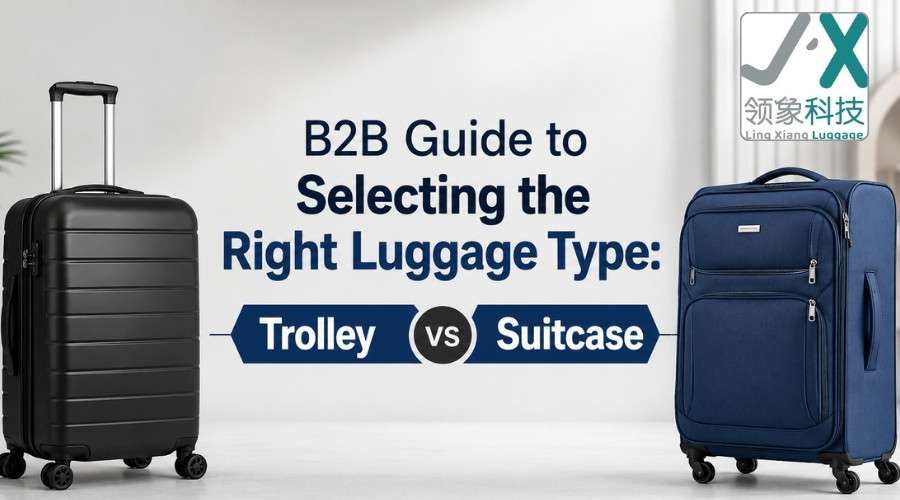
B2B Guide to Selecting the Right Luggage Type: Trolley vs Suitcase
The global luggage market is not just growing. It is reshaping itself right now. In 2025, the market stood at USD 19.58 billion, and forecasts project it will climb to USD 31.71 billion by 2032, growing at a steady 7.12% annually. That growth is fueled by resurgent global travel, rising urbanization, and accelerating product innovation.
Your profit margin lives and dies by the decisions you make in a supplier catalog. Stock the wrong product mix, and you do not just lose a sale. You absorb returns. You field complaints from retailers who cannot move inventory. You watch shipping containers filled with product that missed the mark.
We have put together this guide for the B2B buyer who needs to make concrete data-backed decisions. In this blog we will discuss the distinction between trolley luggage and traditional suitcase luggage, ground every recommendation in market data, and give you a clear framework for building inventory that has top demand and wide market appeal.
Understanding the Basics: Trolley Luggage vs Suitcase Luggage
What is Trolley Luggage?
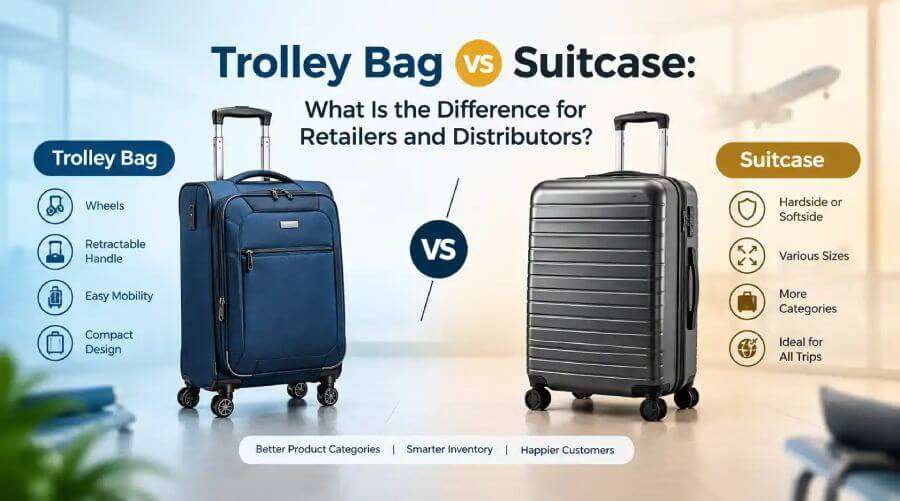
Trolley luggage has two basic features that make it a part of the trolley luggage segment: integrated wheels and a telescopic handle. These are the structured cases you see rolling through airport terminals, carried by business travelers who move fast and pack light.
Start Your Bulk Order for Travel Trolley Bags Now
The category covers three variants: carry-on trolleys that fit overhead bins, aluminum trolley cases positioned in the premium segment, and mid-range polycarbonate models that balance cost with impact resistance. The defining feature is upright rolling mobility that is common to all trolley luggage variants. A traveler does not carry a trolley bag. They steer it.
Production volumes tell you where demand sits. In 2024, global travel suitcase production, which includes trolley bags as a major subset, reached approximately 208.67 million units. And as far as pricing is concerned it stood at an average market of around US$ 62.1 per unit. That is scale worth paying attention to.
What is Suitcase Luggage?
A suitcase, in the traditional sense, prioritizes capacity. It may or may not have wheels. When it does, the wheels are often smaller and the design is oriented toward maximum packing volume, not maximum maneuverability.
Order Lightweight Suitcase Luggage in Bulk Quantities
Suitcases are the standard choices for family vacations and long-haul relocation travel. You will find both hard shell versions for fragile-item protection and soft luggage bags made from nylon or polyester that offer external pockets and flexible expansion. The use case is different. Suitcase buyers think in terms of destination, not transit. They need volume. They need compartments. They are less concerned with gliding through an airport at speed.
Market Demand and Sales Trends in the Travel Industry
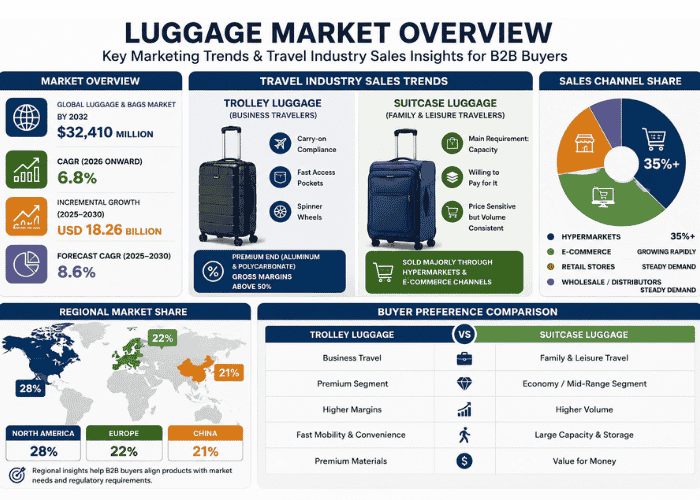
Let us look at the numbers that matter for your procurement planning. The global luggage and bags market is expected to reach $32,410 million by 2032, with a CAGR of 6.8% from 2026 onward. A separate forecast from TechNavio pegs incremental growth at USD 18.26 billion between 2025 and 2030, with a CAGR of 8.6%. These figures reveal a clear segmentation.
Business travelers drive trolley luggage demand. They need carry-on compliance, fast access pockets, and spinner wheels all of which make travel easier and hassle-free. The premium end of this segment, aluminum and high-grade polycarbonate, commands gross margins above 50% for some manufacturers.
Family and leisure travelers drive suitcase luggage demand. Their main requirement is capacity and they are willing to pay for it. They buy through hypermarkets and e-commerce channels, where price sensitivity is higher but volume is consistent. Hypermarkets alone represent over 35% of the global sales channel share.
Regionally, North America leads with roughly 28% market share, followed by Europe at 22% and China at 21%. For B2B distributors, that regional breakdown matters. If your buyers serve European markets affected by evolving EU cabin baggage regulations, your carry-on trolley specifications need to reflect that reality. But if your buyers are in Asia-Pacific, where travel infrastructure spending is accelerating, mid-range and economy options may represent stronger volume opportunities.
Key Differences That Matter for B2B Buyers
Mobility and Convenience
Trolley luggage wins on mobility. Four 360-degree spinner wheels let travelers roll bags upright alongside them. During traveling, that means handling fatigue becomes less and easier handling makes the transit faster through terminals. The telescopic handle is ergonomically designed for prolonged use.
Traditional suitcases, particularly older designs with two inline wheels or no wheels at all, require more physical effort. They strain the wrist. This does not make them obsolete, but their design appeals to a specific target market such as families going on a holiday. Such buyers have no pressure on them to travel fast and have ample time. They can afford to slowly check in at the terminal. They drop the bag at check-in and forget it until baggage claim.
For B2B buyers, the real question to keep in mind is: where does your retail customer sell? Airport retail and online travel marketplaces demand trolley bags. Department stores and wholesale clubs can sell suitcases, especially large checked sizes, all year long.
Storage Capacity and Space Efficiency
A large soft-side suitcase almost always offers more capacity than a trolley of similar external footprint. The walls are thinner. The fabric flexes. External pockets add quick-access volume without expanding the main compartment.
Trolley luggage sacrifices some raw capacity for designated compartment space for various items. The interior features internal dividers, compression straps, and dedicated laptop sleeves segment. That is ideal for a one-night business trip. But the space becomes congested for a family packing for ten days.
On the shipping side, soft suitcases compress when packed into containers, meaning more units per shipment. Hard-shell trolley cases cannot compress. That increases your freight cost per unit. You need to factor this into your landed cost calculations, especially when ordering from overseas factories.
Durability and Material Options
Material choice directly determines your target segment and your pricing power.
Hard shell luggage, typically made from polycarbonate, polypropylene, ABS, or aluminum, offers excellent impact resistance and water protection. Polycarbonate flexes under stress and bounces back. ABS is cheaper but can crack in cold temperatures. Aluminum offers the maximum durability and strength, but is also heavier. That sacrifices a significant portion of the passenger's weight allowance, a fact that matters more now than ever as airlines tighten weight enforcement.
Soft luggage, made from ballistic nylon, high-denier polyester, or Cordura, prioritizes flexibility and affordability. Ballistic nylon has high abrasion resistance. Polyester is widely used in economy-tier luggage. These materials allow for exterior pockets and some degree of overpacking. The trade-off is lower protection for fragile contents and greater vulnerability to water, though modern coatings help.
For B2B buyers, hard-shell polycarbonate targets the premium mid-market. Aluminum targets the luxury tier. Soft-side polyester and nylon serve the volume budget segment and produce healthy margins through scale.
B2B Buying Factors: How to Choose the Right Luggage Type
Product Positioning Strategy
Your product positioning determines your margin structure long before the first unit ships.
A premium segment play, focused on aluminum and polycarbonate trolley luggage, requires investment in branding, packaging, and quality assurance. The gross margins are higher, sometimes exceeding 50%, but the addressable market is narrower. These products sell through specialist retailers and high-end e-commerce.
But if you are catering to a more budget-conscious segment, then offering soft-side suitcases and basic ABS trolleys that prioritize volume is the wining approach. Hypermarkets and large online marketplaces dominate this channel, and price competition is intense. Your profitability depends on supply chain efficiency and container optimization.
The data suggests both segments are healthy. The challenge is choosing one segment and sticking to it, or deliberately segmenting your product catalog to serve both without confusing your brand identity.
Bulk Order Considerations
MOQs vary by factory and material, but hard-shell cases generally require a higher investment. Mold tooling for polycarbonate shells is expensive, and any design change requires a new mold. In contrast, soft-side luggage offers greater flexibility, with lower development costs for new colors and pocket configurations.
Customization matters. Logo embossing, color matching, and interior lining branding help your buyers build brand recognition. Shipping efficiency also matters. Hard cases stack tightly but do not compress. Soft cases compress, letting you fit more units per container and reducing your per-unit freight cost.
Developing a Catalog with a Massive Customer Appeal
A catalog that only shows trolley luggage becomes unappealing to the family vacation retailer. A product mix without carry-on options misses the business travel supplier. Offering both categories signals to your buyers that you understand their full customer base.
One practical approach: structure your catalog into clear use-case segments. Business Travel. Leisure Travel. Premium. Economy. Make it easy for a buyer to see what fits their requirements, as that will persuade them to purchase from multiple segments.
Use Cases: When to Choose Trolley vs Suitcase for Your Inventory
Choose Trolley Luggage If:
You are targeting frequent flyers and business travelers who need cabin-sized dimensions and fast packing and unpacking. Selecting the correct distribution channel is vital to succeed in this niche. Airport retail stores or online travel marketplaces where customers search specifically for carry-on specifications are excellent options to display. Your main focus should be on offering lightweight engineering and durability, not just capacity per dollar.
Airline compliance is a factor you cannot ignore. The industry is consolidating around a universal carry-on standard of 22" x 14" x 9", with stricter enforcement of measurements that include wheels and handles. Stocking trolley bags that meet this standard protects your buyers in a tightening regulatory environment.
Choose Suitcase Luggage If:
You are targeting families and long-haul travelers who check their bags and care about capacity above all else. They shop at wholesale markets, hypermarkets, and department stores where so your distribution strategy should cover those places. Your customers pack for a week, not a night, and they need space for souvenirs on the return trip. Soft-side suitcases offer lower unit costs, greater packing flexibility, and a proven sales record in volume retail.
Why Smart B2B Buyers Stock Both Luggage Types
Diversification is not about hedging. It is about capturing adjacent revenue that would otherwise go to a competitor.
When you offer both trolley luggage and suitcase luggage, you can serve a corporate travel agency and a family vacation wholesaler from the same catalog. You can propose bundle offers, a carry-on trolley paired with a large checked suitcase, that increase average order value and provide a genuine convenience to end customers.
Cross-selling works across segments. A retailer who orders business trolleys in Q1 for the corporate travel season can capitalize on summer holiday demand by ordering large family suitcases in Q2. If your catalog runs deep in only one direction, that second quarter will become a loss for you.
Future Trends in the Luggage Industry
The B2B buyer who looks only at current demand gets caught flat-footed by regulatory shifts and technological change.
Airline policies are reshaping design
The move toward a standardized 22" x 14" x 9" carry-on size, with stricter enforcement, means old mold dimensions will produce non-compliant products. The EU's recent mandate for free carry-on luggage, which requires bags under 7 kg and total dimensions not exceeding 100 cm, will further standardize specifications and may pressure low-cost carrier business models.
Smart luggage is gaining traction
USB charging ports, GPS tracking, and Bluetooth-enabled locking mechanisms represent a fast-growing subcategory. These features appeal to premium buyers and offer differentiation in a crowded market.
Sustainability is transitioning from a marketing claim to a procurement requirement Buyers increasingly request recycled PET fabrics, polycarbonate produced with renewable energy, and packaging free of single-use plastics. The market research consistently identifies sustainability and ethical production as a key growth driver through 2030.
Lightweight hybrid materials are expanding the middle market
Cases that combine a rigid polycarbonate back shell with a flexible textile front panel offer both protection and expandability. These hybrids capture travelers who want hard-shell security without sacrificing the external pocket convenience of soft luggage.
Conclusion
The distinction between trolley luggage and suitcase luggage is not just a product specification. It is a customer segmentation strategy. Trolley luggage serves mobility, business travel, and the premium-on-the-go segment. Suitcase luggage serves capacity, family travel, and volume retail. Both categories are supported by strong, sustained market growth, with the global luggage sector projected to add over USD 18 billion in value by 2030.
Your next step is a practical one. Study your current catalog against the segmentation in this guide. Identify the gap that is costing you orders. Then add a compliant the relevant product line that resolves that gap. Better yet, build a bundle offering that captures both buyers at once.