


Luggage Product Selection: What Distributors Should Consider Before Buying in Bulk
For retailers and distributors, choosing the right luggage products is an important part of building a profitable travel goods range. Buying in bulk requires more than comparing unit prices. Buyers need to consider customer demand, luggage types, sizes, materials, product quality, customization, minimum order quantities, lead times, and expected margins. A well-planned product selection can help B2B buyers reduce slow-moving inventory while offering products that match their target market.
Start With the Luggage Types Your Market Actually Needs
Before placing a bulk luggage order, distributors should understand what their customers are most likely to purchase. Travel habits, customer budgets, destination types, age groups, and trip duration can all influence luggage demand. A retailer serving frequent business travelers may need a different product range from a distributor supplying family travel products, students, or general travel stores.
Instead of selecting products based only on appearance, B2B buyers should compare different luggage categories and identify which products have stronger commercial potential in their market. Reviewing previous sales data, customer inquiries, competitor products, and seasonal demand can help distributors create a product range based on actual purchasing behavior rather than assumptions.
Match Luggage Types With Customer Buying Needs
Customer requirements should be one of the first factors considered when building a luggage range. Some buyers may prioritize lightweight luggage and easy mobility, while others may focus on storage capacity, durability, security features, or affordable pricing. Distributors should understand these differences before deciding which products and specifications to purchase in larger quantities.
For example, business travelers may prefer compact luggage that is easy to carry through airports, while families may require larger cases with more storage capacity. Retailers can also offer different product options for budget-conscious and premium customers. This approach gives buyers more flexibility when creating a luggage collection for different customer groups.
Compare Demand Before Building Your Product Range
Demand analysis can help distributors avoid ordering large quantities of products that may take too long to sell. Before finalizing a bulk order, buyers can review their existing sales performance, customer requests, search trends, competitor product ranges, and seasonal purchasing patterns. This information can help determine which luggage styles deserve more inventory and which should be purchased in smaller quantities.
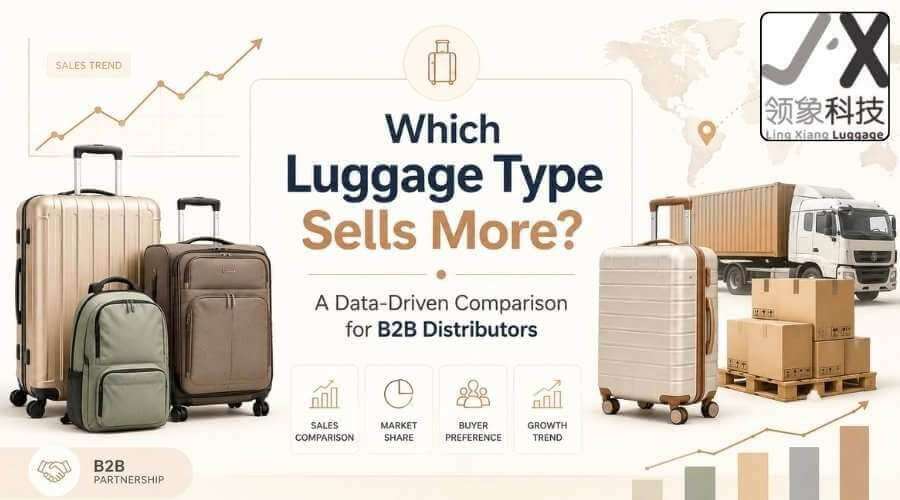
For a deeper comparison of luggage demand and product performance, distributors can also review our article on luggage types that sell more. It provides another useful perspective for B2B buyers who are comparing product categories before making inventory decisions.
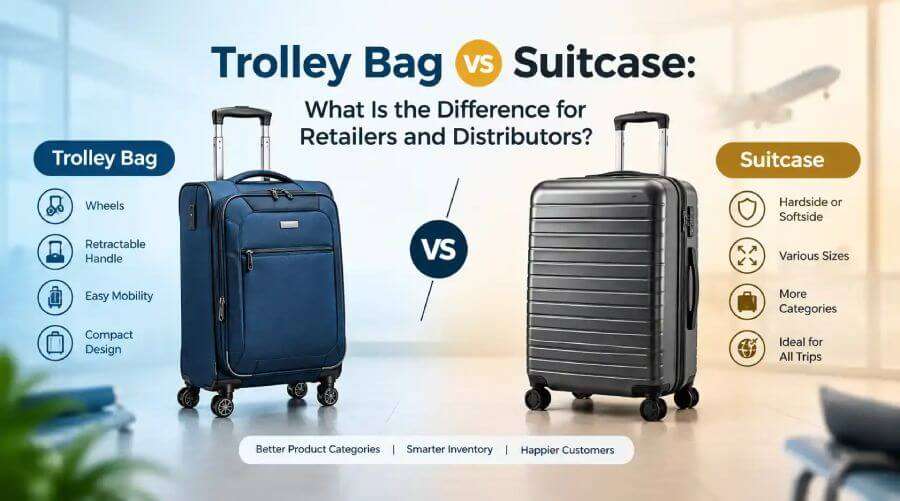
Compare Trolley Bags and Suitcases for Your Product Range
Trolley bags and suitcases can both serve important roles in a B2B luggage product range, but they may appeal to different customer requirements. Distributors should compare factors such as mobility, storage capacity, materials, design, durability, price range, and expected customer use before deciding which products to purchase in larger quantities.
The right choice does not necessarily mean selecting only one type. Many retailers can benefit from offering a combination of luggage products that covers different travel needs and price segments. A balanced selection allows customers to compare options while giving distributors more opportunities to serve different types of buyers.
When Trolley Bags May Be a Better Choice
Trolley bags can be attractive to customers who value easy movement and convenient transportation. Wheels and telescopic handles allow travelers to move luggage through airports, hotels, stations, and other travel environments with less physical effort. For retailers, these features can also create opportunities to offer practical products across different price ranges.
When selecting trolley bags for bulk purchase, distributors should evaluate wheel quality, handle construction, body material, zipper performance, internal organization, and overall product weight. These details can influence customer satisfaction and product durability, so buyers should consider them alongside design and wholesale pricing.
When Traditional Suitcases May Fit Your Market Better
Traditional suitcase designs may appeal to customers who prioritize storage space, structured construction, durability, or a particular travel style. Depending on the market, buyers may also prefer hard shell or fabric options based on price, appearance, weight, and expected use. Understanding these preferences can help distributors decide which suitcase specifications are suitable for their customers.
Distributors comparing these two product categories can also use our resource on trolley bag vs suitcase to understand the main differences between them. This gives B2B buyers another reference point when deciding which luggage products should be included in their wholesale or retail product range.
Build a Balanced Luggage Product Mix for Different Buyers
A strong luggage product range should give customers enough choice without creating unnecessary inventory pressure. Distributors can build a balanced assortment by combining different sizes, materials, colors, designs, and price levels. This approach allows retailers to serve customers with different budgets and travel requirements while maintaining a more organized product portfolio.
Instead of purchasing a large quantity of one product simply because it has a competitive unit price, buyers should consider how each product fits into the overall range. A balanced product mix can include entry-level products for price-sensitive customers, mid-range luggage for general demand, and higher specification products for customers looking for additional features or premium construction.
Offer Different Sizes and Price Points
Luggage size can have a direct impact on purchasing decisions. Cabin size products may appeal to short trip travelers and customers who prefer compact luggage, while medium and large cases can be more suitable for longer trips or family travel. Offering multiple sizes can help distributors address different customer requirements instead of depending on one standard size.
Price segmentation is also important for retailers and distributors. A product range with several price levels can help businesses reach different customer groups. Buyers should compare product specifications and expected resale prices to make sure each price segment provides a reasonable commercial opportunity without creating unnecessary overlap between similar products.
Consider Materials, Colors, and Product Features
Material selection can influence luggage weight, durability, appearance, pricing, and customer perception. Depending on the product range, distributors may consider hard shell materials, fabric construction, lightweight designs, reinforced components, and other specifications. The best choice depends on the target market and the position the product is expected to occupy within the buyer's range.
Colors and features can also influence retail appeal. Popular neutral colors may provide broader market suitability, while specific colors and designs can help retailers create a more distinctive collection. Buyers should also evaluate features such as expandable sections, internal compartments, security locks, handles, wheels, and zipper systems when comparing products.
For buyers who want to understand how different luggage categories can fit into a B2B product range, our article on choosing the right luggage type provides additional information for product selection and comparison.
Evaluate Luggage Quality Before Ordering in Bulk
Quality evaluation is especially important when purchasing luggage in commercial quantities. A small issue with one sample can become a much larger problem when the same specification is produced across hundreds or thousands of units. Poor quality can lead to customer complaints, returns, replacement costs, negative reviews, and reduced confidence in the distributor's product range.
B2B buyers should therefore evaluate both the visible appearance and functional performance of luggage before approving a large order. Samples can help distributors identify construction problems, material differences, finishing issues, and component weaknesses before production moves to a larger quantity.
Check Materials and Overall Construction
The material should be evaluated according to the intended use and expected price level of the product. Buyers should look at the overall construction, shell or fabric quality, stitching, seams, frame structure, zippers, handles, wheels, and internal components. A good appearance is useful, but the product also needs to perform reliably during regular travel.
Distributors should also check whether the supplier can consistently reproduce the approved specifications across the complete order. Consistency matters because commercial buyers need products that maintain similar quality, dimensions, colors, finishing, and component performance from one production batch to another.
Test Wheels, Handles, Zippers, and Other Components
Functional components deserve particular attention because they are frequently used by customers. Wheels should move smoothly, handles should extend and retract properly, and zippers should operate without excessive resistance. Buyers can also inspect locks, stitching, compartments, and connection points to identify areas that could create problems during normal use.
Testing these components before bulk production can help distributors communicate clear quality expectations to the supplier. It is also useful to document approved specifications so that both parties have a clear reference for future production orders.
Request Samples Before a Large Production Order
A sample gives buyers an opportunity to evaluate the actual product instead of relying only on photographs, product descriptions, or specifications. Distributors should review the sample for dimensions, weight, materials, color, finishing, internal space, functionality, packaging, and overall construction before confirming a large order.
If customization is required, the sample can also be used to confirm logo placement, branding, colors, labels, packaging, and other specifications. Approving these details before production can reduce misunderstandings and help ensure that the final shipment matches the buyer's expectations.
Consider MOQ, Pricing, and Profit Margins
Product selection should always be connected to the buyer's purchasing budget and expected sales volume. A low unit price may appear attractive, but a large minimum order quantity can create inventory pressure if the products are difficult to sell. Distributors should therefore evaluate the complete purchasing structure instead of choosing products based only on the quoted unit price.
A commercial purchase should also account for costs beyond the product itself. Shipping, packaging, customization, import charges, payment costs, and other expenses can affect the final landed cost. Understanding these factors helps buyers calculate more realistic margins before committing to a bulk order.
Compare MOQ With Your Expected Sales Volume
Minimum order quantity is an important consideration for distributors because it determines how much inventory must be purchased at one time. Buyers should compare the supplier's MOQ with their expected sales volume, available storage, purchasing budget, and market demand.
A product with a high MOQ may work well for an established distributor with strong demand but create unnecessary risk for a smaller retailer. Where possible, buyers should discuss available order quantities with suppliers and consider whether different products can be combined within a broader purchasing plan.
Calculate the Total Cost of Your Luggage Order
The product price is only one part of the total cost of a bulk luggage purchase. Buyers should consider all major expenses before comparing supplier quotations. A practical cost review can include:
- Product unit price
- Customization or logo charges
- Packaging costs
- Sample and development costs
- Shipping and freight
- Import duties or applicable taxes
- Payment and transaction costs
Calculating the expected landed cost gives distributors a better basis for comparing suppliers and estimating their potential margins. It can also prevent buyers from selecting a supplier that appears cheaper initially but becomes more expensive after shipping, customization, and other charges are included.
Choose Products With Sustainable Margins
A profitable luggage range should balance customer demand, product quality, purchasing cost, and expected resale value. Buyers should compare similar products from different suppliers while also considering their specifications and quality levels. The cheapest product is not always the most commercially suitable option if it has lower durability or limited customer appeal.
Distributors should also consider how quickly the product is expected to sell. A product with a slightly higher purchase cost may still provide better commercial value if it has stronger demand, better quality, and fewer customer complaints or returns.
Choose a Supplier That Supports Your Long-Term Product Strategy
Choosing a supplier is an important step after identifying the luggage products a business wants to sell. Distributors should look beyond the first quotation and evaluate whether the supplier can support repeat orders, product customization, quality consistency, communication, and future expansion.
A reliable supplier relationship can become particularly valuable when a distributor wants to increase order quantities or develop a private label range. Buyers should therefore consider production capabilities, communication, lead times, quality control, customization options, and experience with international B2B orders.
Check Production Capacity and Order Consistency
Production capacity becomes important when demand increases. A supplier may successfully complete a small order but struggle to maintain the same quality or delivery schedule when order quantities become larger. Buyers should ask relevant questions about production capabilities, quality control procedures, lead times, and the supplier's ability to handle repeat orders.
Consistency should also be considered across different production batches. For distributors, maintaining consistent product quality is important because retailers and end customers expect repeat purchases to match the original product specifications.
Review Customization and Private Label Options
Customization can help distributors create a product range that is more closely aligned with their brand and target market. Depending on the supplier's capabilities, buyers may request customized colors, logos, packaging, labels, materials, dimensions, or product features.
For businesses developing a branded luggage range, customization should be discussed before production begins. Buyers should clearly provide branding requirements and confirm whether the supplier can meet the required specifications, MOQ, production timeline, and packaging standards.
Look at Communication, Lead Times, and Export Experience
Clear communication can reduce mistakes during product development and bulk production. Buyers should be able to discuss product specifications, samples, packaging, quality requirements, order quantities, and delivery schedules with the supplier. Quick and accurate communication can be particularly important when dealing with customized products.
Lead time is another factor that distributors should include in their purchasing plans. Buyers should understand sample timelines, production timelines, shipping arrangements, and any factors that could affect delivery. Suppliers with experience handling international B2B orders may also be better prepared to manage the documentation and coordination required for overseas shipments.
How Lingluggage Can Support Bulk Luggage Sourcing
Lingluggage can support B2B buyers that need luggage products for wholesale distribution, retail sales, or customized product ranges. For distributors, working with a supplier that understands bulk purchasing requirements can make it easier to discuss product specifications, quantities, customization, quality expectations, and delivery requirements before production begins.
When evaluating a luggage supplier, buyers should clearly communicate their target market and purchasing requirements. This can include the type of luggage required, preferred materials, sizes, colors, estimated quantity, branding requirements, packaging preferences, and delivery destination. Providing detailed information helps suppliers prepare more relevant product recommendations and quotations.
Discuss Your Requirements Before Placing an Order
Before requesting a quotation, buyers should prepare a clear product brief. The brief should explain what type of luggage is required and what specifications are important for the target market. This allows the supplier to understand the commercial purpose of the order rather than providing a quotation based only on a general product name.
Useful information can include:
- Product type and size
- Preferred material
- Required quantity
- Target price range
- Logo or private label requirements
- Packaging requirements
- Preferred colors and design
- Delivery destination
A clear brief can make communication more efficient and help buyers compare quotations on a similar basis.
Request Samples and Confirm Specifications
Before approving a large production order, distributors should confirm the product specifications through samples and written requirements. Buyers can use this stage to evaluate quality, functionality, dimensions, materials, colors, branding, packaging, and other important details.
Once the sample and specifications are approved, buyers should keep a clear record of the agreed requirements. This provides a useful reference for production and future repeat orders and can help reduce misunderstandings between the buyer and supplier.
Final Checklist for Choosing Luggage Products in Bulk
Before placing a bulk luggage order, distributors should review the complete purchasing decision rather than focusing on only one factor. The following checklist can help buyers organize their evaluation:
- Target market and customer requirements
- Luggage type and product category
- Available sizes and price points
- Materials and construction quality
- Product features and functionality
- Sample approval
- Minimum order quantity
- Total landed cost
- Expected profit margin
- Customization and private label options
- Production capacity
- Quality consistency
- Lead time
- Packaging requirements
- Shipping and delivery arrangements
A supplier that meets these requirements can make bulk purchasing easier to manage, but buyers should still evaluate every order according to their own market and commercial objectives. Careful product selection at the beginning can help distributors build a stronger luggage range and reduce the risks associated with unsuitable inventory.
Frequently Asked Questions About Bulk Luggage Sourcing
What should distributors consider when selecting luggage products?
Distributors should consider customer demand, luggage type, size, materials, product quality, features, wholesale price, MOQ, customization, production capacity, lead time, shipping costs, and expected resale margins. These factors help buyers select products that fit their target market and reduce the risk of purchasing inventory that may be difficult to sell.
Is it better to buy trolley bags or traditional suitcases in bulk?
There is no single option that works for every market. Trolley bags may appeal to customers who prioritize mobility and convenience, while traditional suitcase designs may suit buyers looking for specific storage, construction, or pricing options. Distributors should compare their customer demand and product positioning before deciding which type to purchase.
What should I check before ordering luggage from a manufacturer?
Buyers should check materials, construction, wheels, handles, zippers, dimensions, weight, finishing, packaging, MOQ, pricing, customization options, production capacity, and lead times. Requesting samples before placing a large order is also recommended because it allows distributors to evaluate the actual product quality before committing to bulk production.
How can distributors choose the right luggage supplier?
Distributors should compare suppliers based on product quality, production capability, pricing, MOQ, customization support, communication, lead times, quality consistency, and experience with B2B orders. A supplier should be able to meet current purchasing requirements while also providing enough production and customization support for future business growth.
What information should I provide when requesting a bulk luggage quotation?
Buyers should provide the required luggage type, quantity, sizes, materials, colors, customization requirements, logo details, packaging preferences, target market, and delivery destination. The more specific the product requirements are, the easier it is for suppliers to provide an accurate quotation and confirm whether they can meet the buyer's requirements.
Conclusion
Choosing the right luggage products for bulk purchasing requires more than comparing product prices. B2B distributors and retailers need to consider customer demand, luggage types, product quality, sizes, materials, MOQ, customization, supplier capabilities, lead times, and expected profit margins before making a purchasing decision. A well-planned product range can help businesses serve different customer groups while reducing the risk of slow-moving inventory.
For distributors, the best approach is to build a product selection around their target market and then evaluate suppliers based on their ability to provide consistent quality, competitive pricing, customization support, and reliable production. Reviewing samples before bulk production and clearly confirming product specifications can also help prevent quality and communication issues.
Whether you are expanding an existing luggage range or preparing your first wholesale order, careful product selection can make your purchasing process more efficient. By comparing customer needs, product specifications, supplier capabilities, and total costs, B2B buyers can create a luggage range that supports long-term sales and business growth.