


Trolley Bag vs Suitcase: What Is the Difference for Retailers and Distributors?
When customers search for luggage, they often use terms like trolley bag, suitcase, trolley suitcase, and rolling suitcase interchangeably. However, these terms can describe slightly different product features and categories. For retailers and distributors, understanding the difference between a trolley bag and a suitcase can make product classification, inventory management, and customer communication easier. A clear luggage category structure also helps buyers compare products based on size, material, wheels, capacity, and travel purpose.
Lingluggage offers a range of options designed for different travel and business needs. From trolley bags and rolling suitcases to other practical luggage styles, buyers can choose products based on size, wheel design, material, storage capacity, and intended use.
What Is a Trolley Bag?
A trolley bag is a type of travel luggage designed with wheels and a retractable handle that allows users to pull or push the bag with less physical effort. Most modern trolley bags have either two wheels or four wheels and are available in different sizes, materials, and designs. They are commonly used for airport travel, business trips, holidays, and other situations where users need to move luggage over different surfaces.
The main feature of a trolley bag is its mobility. Instead of carrying the entire weight by hand, travelers can extend the telescopic handle and roll the luggage. This makes trolley bags practical for people who travel frequently or need to move luggage through airports, railway stations, hotels, and city streets. For retailers, these features are also useful when creating product categories and comparing different luggage models.
Common Types of Trolley Bags
Trolley bags are available in different configurations, so retailers should avoid treating every trolley bag as the same product. Size, wheel design, material, and internal capacity can create important differences between products. When building an inventory, these attributes can be used to create clear subcategories and make it easier for wholesale buyers and customers to find suitable products.
Common trolley bag types include:
• 2 wheel trolley bags for simple pulling and compact travel
• 4 wheel spinner trolley bags for easier movement in different directions
• Softside trolley bags with flexible fabric construction
• Hardside trolley bags with a rigid outer shell
• Cabin trolley bags designed for shorter trips and carry on use
• Large trolley bags designed for longer trips and higher luggage capacity
What Makes a Trolley Bag Different?
The main difference is the combination of wheels and a retractable handle. These features allow the user to move the luggage without carrying it for the entire journey. Trolley bags can also include additional handles on the top and side, making them easier to lift when using stairs, loading vehicles, or placing luggage into storage areas.
For retailers and distributors, important trolley bag features include:
• Wheel configuration and wheel quality
• Telescopic handle construction
• Bag size and dimensions
• Internal storage capacity
• Outer material and durability
• Zippers and locking systems
• Number of compartments and pockets
• Weight of the empty bag
These specifications can be included in product listings so buyers can understand the product without relying only on the general term “trolley bag.”
What Is a Suitcase?
A suitcase is a broader type of travel luggage used to carry clothing, personal belongings, business items, and other travel essentials. Traditional suitcases were often carried using fixed handles, but modern suitcases commonly include wheels and telescopic handles. Because of this development, the terms suitcase and trolley bag can overlap in the modern luggage market.
Suitcases are available in different shapes, sizes, materials, and internal layouts. Hardside suitcases generally use materials such as ABS, polycarbonate, or other rigid plastics, while softside models commonly use fabric materials. Retailers can organize suitcase products according to size, material, wheel configuration, capacity, and intended travel purpose.
Common Types of Suitcases
A suitcase category can include several product groups. Carry on suitcases are designed for shorter trips and airline cabin use, while medium and large suitcases provide more space for longer travel. Retailers can also divide products according to construction, such as hardside and softside models.
Common suitcase categories include:
• Carry on suitcases
• Cabin suitcases
• Medium suitcases
• Large suitcases
• Hardside suitcases
• Softside suitcases
• 2 wheel rolling suitcases
• 4 wheel spinner suitcases
This classification makes it easier to manage different products while also helping customers understand how one suitcase differs from another.
Are All Trolley Bags Suitcases?
Many trolley bags can be considered suitcases, especially when they have a traditional suitcase shape, internal compartments, and a rigid or fabric luggage body. However, the word trolley often focuses more on the mobility system, particularly the wheels and retractable handle. The word suitcase is usually broader and describes the overall luggage product rather than one specific wheel or handle configuration.
For ecommerce retailers, using both terms can sometimes provide better product clarity. For example, a product can be described as a 4 wheel trolley suitcase or rolling suitcase. This tells the customer what the product is and also explains how it moves. It can also create a clearer structure for product categories and search terms.
Difference Between Trolley and Suitcase
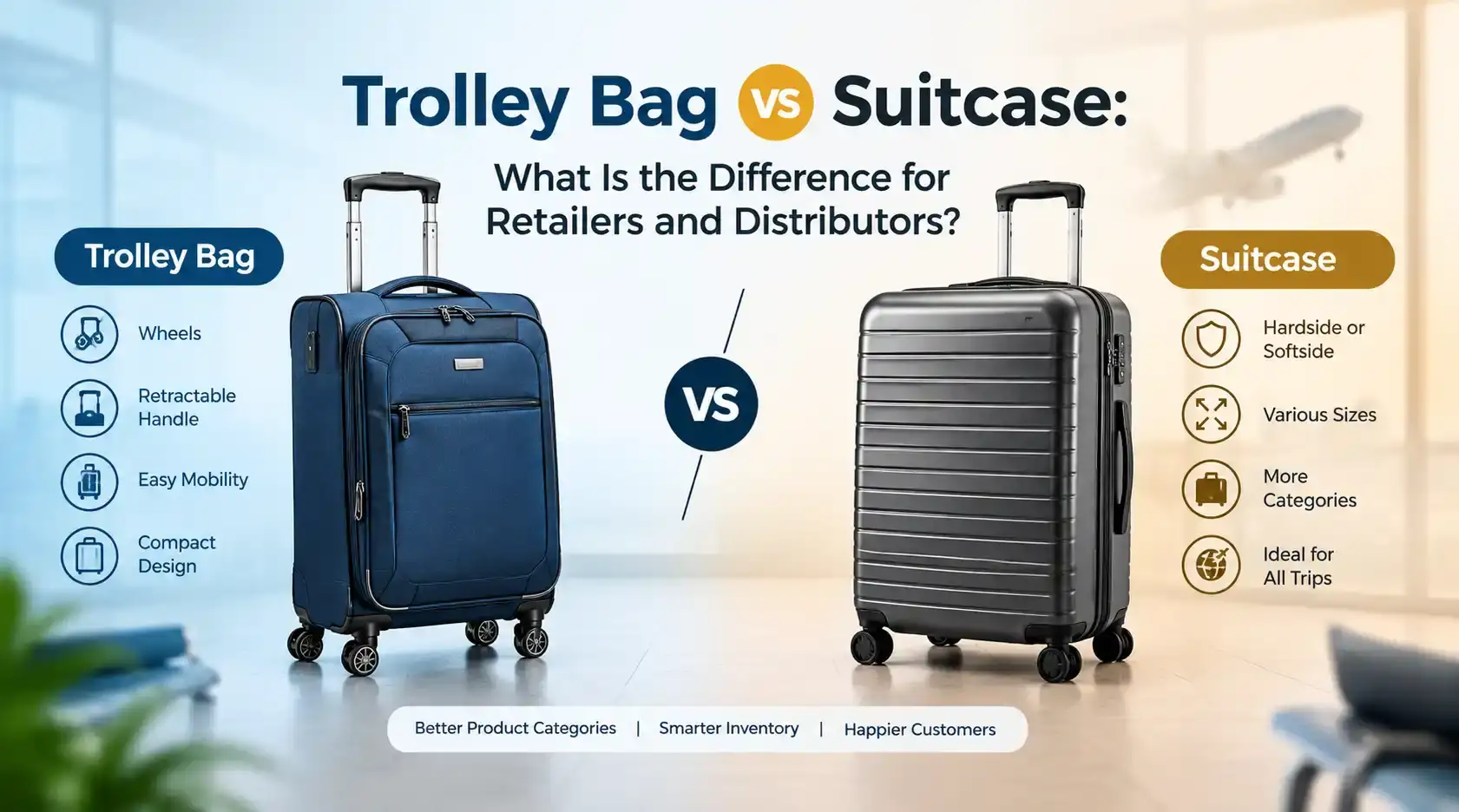
The difference between a trolley bag and a suitcase is mainly related to terminology and product features. A trolley bag usually emphasizes the rolling system and retractable handle, while suitcase is a broader term for travel luggage. Modern products often combine both concepts, which means a trolley bag can also be classified as a rolling suitcase.
|
Feature |
Trolley Bag |
Suitcase |
| Main meaning | Luggage designed for rolling | General travel luggage category |
| Wheels | Usually includes wheels | May include wheels or may be non rolling |
| Handle | Usually has a retractable handle | Can have fixed or retractable handles |
| Construction | Softside or hardside | Softside or hardside |
| Mobility | Designed for easy movement | Depends on the product design |
| Common types | 2 wheel and 4 wheel trolley bags | Carry on, medium, large, rolling and traditional suitcases |
| Retail classification | Often classified by wheel system and size | Often classified by type, size, material and use |
For retailers and distributors, the important point is that these terms are not always completely separate categories. A product may be marketed as a trolley bag by one supplier and as a rolling suitcase by another. Checking the actual product specifications is therefore more useful than relying only on the product name.
Trolley Bag vs Suitcase for Retailers and Distributors
Retailers and distributors need a clear product structure because luggage collections can contain many products with similar appearances. If trolley bags, rolling suitcases, cabin luggage, and large suitcases are placed into unclear categories, customers may have difficulty finding the right product. A well planned category system can separate products according to their actual characteristics while keeping related products connected.
For wholesale buyers, this structure is also important because they may order multiple suitcase models for different customer groups. A distributor may need compact cabin luggage for business travelers, medium luggage for general travel, and large luggage for longer trips. Each product should therefore have clear information about its size, material, wheels, capacity, and other important specifications.
How to Categorize Trolley Bags in Inventory
When adding trolley bags to inventory, retailers can use several product attributes instead of relying on one general category. This approach can make stock management easier and reduce confusion between products that look similar but have different specifications.
Useful inventory attributes include:
• Wheel type: 2 wheel or 4 wheel
• Size: cabin, small, medium or large
• Material: ABS, polycarbonate, polyester or other materials
• Construction: hardside or softside
• Capacity: measured according to the product specification
• Handle: telescopic or fixed
• Lock: standard zipper, combination lock or other system
• Travel use: business, leisure, short trip or long trip
Using these attributes can help retailers build a more organized luggage inventory and make product filtering easier for customers.
How to Categorize Suitcases in Inventory
Suitcase inventory can be organized using a combination of product type, size, construction, wheel system, and intended use. Instead of creating too many separate categories, retailers can establish a main suitcase category and then use subcategories or product filters for important attributes.
A simple structure could look like this:
• Luggage
• Suitcases
• Rolling Suitcases
• Carry On Suitcases
• Medium Suitcases
• Large Suitcases
• Hardside Suitcases
• Softside Suitcases
Retailers can then add additional product attributes such as color, material, capacity, number of wheels, lock type, and internal compartments. This makes the inventory easier to manage while giving customers more useful information during product selection.
Which Features Should Retailers Compare Before Stocking?
When retailers and distributors source luggage, product names should not be the only consideration. Two products can both be called trolley bags but have different wheel quality, materials, dimensions, capacity, and construction. Comparing these details before stocking products can help businesses create more accurate product listings and select luggage that matches the needs of their target market.
Important features to compare include:
• Product dimensions
• Empty luggage weight
• Storage capacity
• Wheel configuration
• Wheel material and construction
• Telescopic handle design
• Outer shell or fabric material
• Zipper quality
• Locking system
• Interior compartments
• Lining and internal organization
• Available colors and designs
• Packaging dimensions
• Shipping weight
These specifications are especially useful for distributors because they help compare products from different suppliers using the same basic criteria. They can also support clearer wholesale quotations and product catalogs.
How to Build a Better Luggage Category Structure
A good luggage category structure should be simple enough for customers to understand but detailed enough for retailers to manage their inventory. The main category can start with luggage, followed by product types such as suitcases, travel bags, backpacks, and other luggage products. Suitcases can then be divided according to useful characteristics such as size, construction, and wheel configuration.
For example, a retailer could organize rolling suitcase products like this:
Luggage → Suitcases → Rolling Suitcases → 4 Wheel → Hardside → Carry On
This structure creates a clear relationship between the main luggage category and the product attributes. It also supports searches related to rolling suitcase category taxonomy and suitcase category taxonomy because each product can be described using specific and meaningful attributes.
Use Product Attributes Instead of Too Many Categories
Creating a separate category for every small product difference can make an ecommerce website difficult to navigate. For example, retailers do not necessarily need separate top level categories for every color, handle type, or wheel design. These details can often work better as product attributes or filters.
A practical category system can use:
• Product type as the main category
• Size as a subcategory or filter
• Material as a product attribute
• Wheel type as a product attribute
• Capacity as a specification
• Travel purpose as a filter
• Design and color as product variations
This approach keeps the website structure clean while still providing detailed information to buyers.
Trolley Bag vs Suitcase: Which Category Should You Use?
There is no need to treat trolley bag and suitcase as completely separate concepts in every inventory system. The better approach is to understand what each term communicates. Trolley bag highlights the rolling function and retractable handle, while suitcase describes the wider travel luggage product. A rolling suitcase can therefore combine both terms and provide a more specific product description.
For product listings, retailers can use terminology based on the actual product. For example, a four wheel hardside suitcase with a telescopic handle can be described as a 4 Wheel Hardside Trolley Suitcase. This gives buyers information about the product type, wheel system, construction, and overall design in one description.
When to Use the Term Trolley Bag
The term trolley bag can be useful when the rolling system is an important part of the product description. It is commonly used for products with wheels and a pull handle, especially in markets where customers regularly use the phrase trolley bag when searching for rolling luggage.
Retailers can use this term when:
• The product has wheels
• The product includes a retractable handle
• Customers commonly search for trolley luggage
• The product is designed for easy rolling
• The product listing needs to explain its mobility
When to Use the Term Suitcase or Rolling Suitcase
The term suitcase is useful when discussing the broader travel luggage category. Rolling a suitcase is more specific because it immediately tells the customer that the suitcase has wheels. For ecommerce product pages, using a specific phrase can make the product easier to understand.
For example:
• Suitcase for a general luggage category
• Rolling suitcase for a wheeled suitcase
• Trolley suitcase for a suitcase with a trolley handle
• Carry on suitcase for compact travel luggage
• Hardside suitcase for rigid shell luggage
Using clear terminology throughout product titles, categories, descriptions, and filters can help retailers create a more consistent shopping experience.
What Should Retailers Consider When Choosing Luggage Categories?
Retailers should consider how their customers search for products, how suppliers describe products, and how the business manages inventory. A category structure should not be based only on popular product names. It should also reflect real product differences that matter to buyers, such as size, material, wheel system, capacity, and travel purpose.
A practical luggage category structure should make it easy to answer questions such as:
• What type of luggage is this?
• How large is it?
• Does it have wheels?
• Does it have two wheels or four wheels?
• Is it hardside or softside?
• How much can it hold?
• What type of travel is it designed for?
• What materials are used?
When these details are easy to find, buyers can compare products more quickly without reading long descriptions for basic specifications.
FAQs About Trolley Bags and Suitcases
What Is the Difference Between a Trolley Bag and a Suitcase?
A trolley bag usually refers to luggage with wheels and a retractable handle that allows the user to pull or push it. A suitcase is a broader term for travel luggage and can include both rolling and non rolling designs. Many modern trolley bags are therefore also classified as rolling suitcases.
Is a Trolley Bag Considered a Suitcase?
Yes, many trolley bags can be considered suitcases when they have a suitcase style body, internal compartments, and travel luggage construction. The terms can overlap because trolley describes important mobility features while suitcase describes the wider luggage product. Retailers can use more specific terms such as trolley suitcase or rolling suitcase when appropriate.
Are Trolley Bags Better for Travel Than Traditional Suitcases?
The suitability of a trolley bag depends on how and where the luggage will be used. Wheeled trolley bags can make movement easier across suitable surfaces, while other suitcase designs may be selected for different travel needs. Retailers should compare wheel design, size, weight, capacity, material, and handle construction before choosing products for their customers.
How Should Retailers Categorize Trolley Bags and Suitcases?
Retailers can start with a main luggage category and then organize products by suitcase type, size, material, wheel configuration, and travel purpose. For example, rolling suitcases can be divided into carry on, medium, and large sizes. Product attributes can then identify hardside or softside construction, wheel type, capacity, and other specifications.
Conclusion
Trolley bags and suitcases are closely related luggage categories, and their terminology can overlap depending on the supplier, retailer, and market. The main distinction is that trolley bag usually emphasize wheels and a retractable handle, while suitcase is a broader term for travel luggage. For retailers and distributors, understanding this difference can make inventory classification and product presentation much clearer.
Instead of creating confusing or overlapping categories, businesses can organize luggage according to practical product characteristics such as size, material, wheel configuration, capacity, construction, and travel purpose. A clear structure helps wholesale buyers compare products and allows retailers to present their luggage collections in a simple and organized way. When product names are combined with accurate specifications, both inventory management and customer product discovery can become easier.
More blogs like this:
B2B Guide to Selecting the Right Luggage Type: Trolley vs Suitcase
Which Luggage Type Sells More? A Data-Driven Comparison for B2B Distributors